
The most effective workout plan you'll ever follow is the one you abandon in week three. Not because you lack discipline, but because it was designed for someone who doesn't exist: a version of you with perfect sleep, zero stress variability, and joints that feel the same every morning. The breakthrough in AI fitness coaching isn't that machines can count reps or suggest exercises. It's that they can finally do what human trainers rarely have time for: adjust the plan every single day based on who you actually are right now.
The Problem with How We Currently Approach This
Traditional fitness programming operates on a fundamental assumption: that your body and life circumstances remain stable enough to follow a predetermined schedule. You're handed a 12-week plan with prescribed exercises, sets, reps, and rest days. Maybe it's from a certified trainer, maybe it's from an app that asked five onboarding questions. Either way, the underlying model is static.
This approach made sense in a world where personalization was expensive. A human trainer can't feasibly check your sleep data, cross-reference your calendar for stress load, assess your recovery markers, and reformulate your workout every morning for dozens of clients. So we accepted the compromise: a good-enough template executed with willpower.
The problem emerges around week three. You get sick. Work explodes. You sleep poorly for four nights running. Your knee feels off. The plan doesn't know any of this. It still prescribes heavy squats on Tuesday because that's what the spreadsheet says. You have three choices: push through and risk injury or burnout, skip the workout and feel guilty, or abandon the plan entirely because it clearly wasn't built for your actual life.
Most people choose option three. We've been conditioned to interpret this as personal failure, a lack of commitment. But the failure is architectural. A static plan can't respond to a dynamic system. Your body isn't a machine that produces consistent output given consistent input. It's an adaptive organism embedded in a complex life with variable sleep, stress, nutrition, recovery capacity, and competing demands.
Even the best human trainers hit limits here. They can adjust when you tell them something's wrong, but that requires you to recognize the signal, articulate it, and wait for a response. Most adaptation needs to happen faster and more quietly than that. The form of fitness programming we've inherited was never designed to handle the granularity of real human variability.
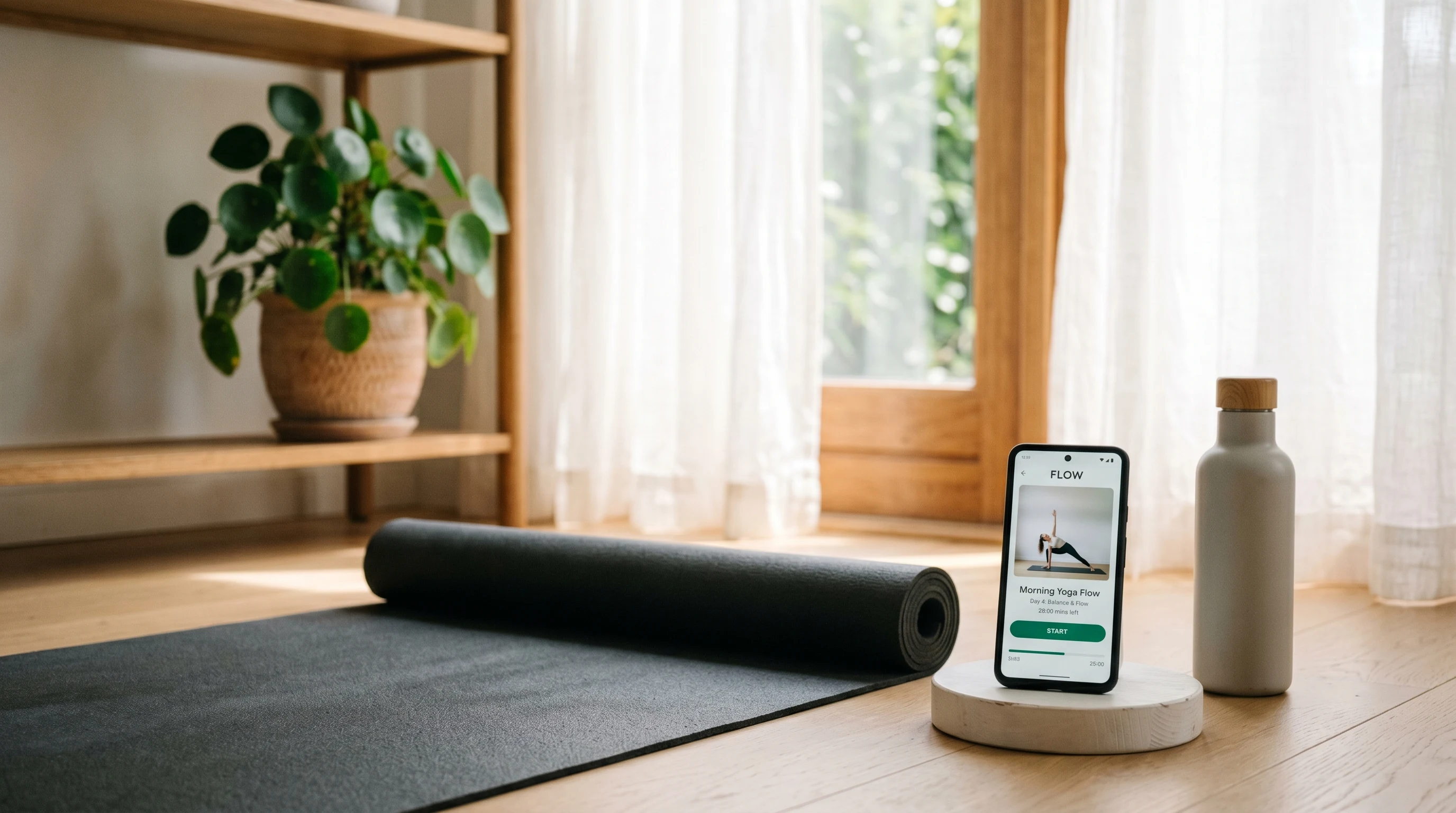 AI fitness coach interface on smartphone next to yoga mat in naturally lit room
What We've Observed at LIFE
When we built CORTEX, LIFE's reasoning engine, we designed it to run continuously across all thirteen modules rather than treating fitness as an isolated domain. What emerged surprised us. The patterns that predict workout success or failure rarely originate in the Move module itself.
The clearest signal comes from sleep architecture. Users who complete workouts that feel subjectively "right" almost always show consolidated deep sleep in the 90–120 minute range over the previous night. Not total sleep duration, specifically deep sleep consolidation. When that number drops below 60 minutes, the same prescribed workout generates completion rates that fall by more than half, and subjective difficulty ratings nearly double. The workout didn't change. The system executing it did.
Stress accumulation shows up differently. We track calendar density, email volume, and task load across a rolling seven-day window. When this composite stress signal crosses certain thresholds, users who push through high-intensity workouts report feeling worse afterward, not better. Their recovery metrics confirm it. Heart rate variability drops, resting heart rate climbs, subjective energy scores decline over the following 48 hours. They did the workout. The workout made them less fit.
This creates a paradox that static plans can't resolve. The times when you feel most compelled to "stay disciplined" and stick to the prescribed hard workout are often precisely the times when a different stimulus would serve you better. Not because you're weak, but because adaptation requires resources your system is currently allocating elsewhere.
We've also observed that workout adherence correlates more strongly with contextual relevance than with enjoyment or even results. Users stick with routines that acknowledge their current constraints. A 15-minute mobility session that fits before an early meeting gets completed at twice the rate of a 45-minute "optimal" workout that requires rescheduling three other things. The 15-minute session also produces better outcomes over time, because consistency at 70% intensity beats sporadic efforts at 100%.
The relationship between workout timing and energy availability is more precise than we expected. CORTEX cross-references calendar blocks, meal timing, and historical energy patterns to identify windows when users are both available and physiologically prepared. Moving a workout by just two hours, from immediately after waking to mid-morning post-breakfast, can shift completion rates by 30–40% for certain chronotypes.
Perhaps most striking: users who receive daily workout adjustments based on this kind of integrated data don't experience them as modifications or setbacks. They report feeling "seen" by the system. The ai training assistant isn't delivering bad news when it suggests scaling back intensity. It's confirming what the user's body was already signaling, giving them permission to train intelligently rather than rigidly.
The Framework: Adaptive Load Architecture
The shift from static programming to intelligent coaching requires rethinking how we structure fitness itself. We call this Adaptive Load Architecture, a framework built on continuous system assessment rather than predetermined periodization.
Layer 1: Readiness Over Schedule
Traditional plans organize around time: what you do Monday, Wednesday, Friday. Adaptive Load Architecture organizes around readiness: what you do when your system can absorb and adapt to which kinds of stimulus.
Readiness isn't binary. It's a composite signal drawn from sleep quality, recovery markers, accumulated stress, nutrition patterns, and time since last similar stimulus. A sophisticated ai workout planner evaluates these inputs every morning and determines not just whether you should train, but what kind of adaptation your system is prepared to pursue today.
This means some mornings call for strength work, others for aerobic base building, others for mobility and breathwork. The sequence isn't random, but neither is it predetermined. It emerges from continuous assessment of your actual capacity right now.
Layer 2: Progressive Stimulus Across Domains
Fitness has multiple distinct qualities: strength, power, aerobic capacity, anaerobic threshold, mobility, stability, skill acquisition. Each has different recovery demands and different windows of adaptation.
Rather than periodizing these linearly (strength phase, then conditioning phase, then maintenance), Adaptive Load Architecture layers them intelligently. You might do strength work for lower body while maintaining upper body, build aerobic base while preserving mobility, or focus on skill acquisition during periods when stress load makes high-intensity work counterproductive.
The personalized fitness ai tracks which qualities need attention based on assessment data, which are maintaining adequately, and which need temporary de-prioritization. This creates a multidimensional approach where you're always training everything at appropriate dosages rather than cycling through single-focus blocks.
Layer 3: Recovery as Primary Metric
Most training systems treat recovery as the space between workouts. Adaptive Load Architecture treats it as the workout's most important outcome. The question isn't "did you complete the prescribed work?" It's "did your system absorb that work and move toward adaptation?"
This requires measuring recovery explicitly. Heart rate variability trends, subjective energy ratings, sleep architecture changes, appetite signals, mood stability—these aren't secondary metrics, they're primary feedback. When they indicate incomplete recovery, the architecture adjusts load automatically. Not because you failed, but because the system is functioning as designed.
An ai recovery balance system doesn't just recommend rest days. It calibrates the relationship between stimulus and recuperation continuously, ensuring that every workout creates a debt your system can realistically repay.
Layer 4: Context-Aware Modulation
Your training capacity isn't isolated from the rest of your life. A workout that's appropriate on a light calendar day with good sleep becomes inappropriate when you're managing a deadline, traveling, or dealing with emotional stress.
Adaptive Load Architecture pulls data from calendar density, email volume, travel schedules, and social commitments to understand your total system load. It treats these as training stressors because physiologically, they are. Cortisol doesn't distinguish between a hard workout and a hard meeting.
When non-training stress is elevated, the architecture automatically modulates workout intensity and duration to match available adaptive capacity. This isn't compromise, it's intelligent periodization at the highest resolution: daily instead of weekly or monthly.
 Fitness tracker on wrist during stretching exercise with natural lighting
Layer 5: Movement Quality Before Volume
Static plans optimize for completion: did you do the prescribed sets and reps? Adaptive Load Architecture optimizes for quality: did you move well, maintain positions correctly, and execute with appropriate control?
This matters because compensation patterns and poor movement quality create their own stress and injury risk, often silently. An ai mobility coach can use movement assessment to identify when fatigue or limited range of motion is causing compensations, then adjust the workout in real-time to address the limitation rather than reinforcing it.
Some days this means scaling back weight or complexity. Other days it means spending ten minutes on targeted mobility work before a strength session. The architecture prioritizes long-term movement health over short-term volume metrics.
How LIFE Implements This
LIFE's Move module doesn't ask you to log workouts after the fact. It generates them every morning based on what CORTEX observes across all thirteen modules.
When you open Move, you see today's recommended session. Not this week's plan—today's. It's already been adjusted for your sleep data from Body, your calendar load from Calendar, your stress signals from Mind, and your recovery trends tracked over the previous week.
The workout itself includes video demonstrations, but more importantly, it includes rationale. Why this session today? Why this intensity? What are we trying to adapt? This transparency builds trust and helps you internalize the logic, making you a better self-coach over time.
During the workout, the Move module doesn't just track completion. If you're using connected devices, it monitors heart rate, power output, or movement velocity. If metrics suggest you're under-performing relative to recent sessions, it suggests modifications in real-time. Drop a set. Reduce load. Extend rest. The goal isn't to push through, it's to match stimulus to current capacity.
After training, Move prompts you for subjective feedback: How did that feel? Any pain or discomfort? Energy level? This qualitative data flows back into CORTEX alongside the quantitative metrics. Tomorrow's session will reflect both.
The module also integrates progressive assessment. Every few weeks, CORTEX schedules standardized evaluation sessions—benchmark lifts, timed efforts, movement screens—that measure actual adaptation rather than just effort accumulation. These assessments inform programming direction, ensuring the architecture doesn't just react to daily readiness but also pursues deliberate long-term development.
CORTEX's advantage is integration. It sees that you have a high-stakes presentation Thursday, so Wednesday becomes a moderate session and Thursday becomes active recovery. It notices your email volume doubled this week and your deep sleep declined, so it suggests restorative yoga instead of the heavy lifting that would have been appropriate last week. It recognizes you've traveled across time zones and adjusts both intensity and timing to match your disrupted circadian rhythm.
You're not managing any of this manually. CORTEX is doing what a world-class coach with unlimited attention and perfect information would do: watching everything, connecting patterns, and adjusting the plan continuously to serve your actual goals in your actual life.
Putting It Into Practice This Week
Even without AI orchestration, you can begin implementing Adaptive Load Architecture principles immediately.
Start with a morning readiness check. Before looking at your planned workout, spend two minutes assessing: How did you sleep? How does your body feel? What's your calendar load today? What's your subjective energy level, one to ten? Write these down. Over time, you'll develop pattern recognition that helps you adjust intelligently.
Make readiness-based modifications. If your assessment suggests low readiness, modify the day's plan proactively. Reduce volume by 20–30%, drop intensity by one level, or substitute a lower-stress modality entirely. Track these decisions and note how you feel afterward. You're learning to calibrate stimulus to capacity.
Track recovery, not just workouts. Add one recovery metric to your routine: morning resting heart rate, heart rate variability via a free app, or simply a subjective recovery score. Watch how it responds to different training loads and life stressors. Let it inform your intensity decisions.
Integrate calendar awareness. Each Sunday, review the coming week's calendar. Identify high-stress days, early commitments, travel, and social obligations. Proactively adjust your workout plan to account for these loads. Schedule lower-intensity sessions on high-stress days, and protect your hardest training for days with margin.
Prioritize one movement quality drill. Before each strength or conditioning session, spend five minutes on a targeted mobility or stability drill relevant to that session. Hip mobility before squats. Thoracic rotation before overhead work. Shoulder stability before pressing. This small investment reduces compensation patterns and improves long-term movement health.
The goal isn't perfection. It's developing a practice of continuous adjustment based on actual system state rather than predetermined templates. Even manual implementation of these principles will dramatically improve both adherence and outcomes.
FAQ
Is an ai fitness coach suitable for beginners?
Yes, particularly so. Beginners benefit most from appropriate load calibration and movement quality focus, both areas where AI excels. A good AI system prevents the most common beginner mistake: doing too much too soon because you don't yet recognize your body's recovery signals. It also provides consistency and structure without requiring you to understand program design, letting you focus on execution and habit formation while the system handles progression logic.
How is an ai workout planner different from a fitness app with pre-built programs?
Traditional fitness apps deliver static programs with minimal personalization—perhaps choosing between beginner, intermediate, and advanced versions. An AI workout planner generates unique sessions daily based on your current readiness, recovery state, schedule constraints, and progress toward goals. The difference is continuous adaptation versus predetermined templates. One responds to who you are today; the other assumes you're consistent across time.
Can I use AI fitness coaching without wearable devices?
Yes. While devices like heart rate monitors and sleep trackers provide valuable data, a capable AI system can work with subjective self-reporting. Daily ratings of sleep quality, energy level, soreness, and workout difficulty provide sufficient signal for intelligent adaptation. Devices increase precision, but the architecture functions on qualitative patterns. Many users start with self-reporting and add devices later as they recognize the value of objective metrics.
What's the best way to combine AI coaching with a human trainer?
They complement beautifully. A human trainer provides expertise in technique coaching, motivation, and complex program design for specific goals. The AI handles daily adjustment, recovery monitoring, and integration with your broader life. Think of the trainer as setting strategic direction and teaching skills, while the AI manages tactical execution and continuous optimization. Many trainers now use AI tools themselves to manage larger client rosters without sacrificing personalization.
How does an ai training assistant handle injury or pain?
Quality AI systems include pain screening and movement assessment protocols. When you report pain, the system adjusts programming to avoid aggravating movements while maintaining training in unaffected areas. It can guide you through rehabilitation progressions for minor issues. However, AI should never replace medical diagnosis. For acute injuries or persistent pain, consult a healthcare provider. The AI's role is supporting recovery and preventing compensation patterns, not diagnosing pathology.
Is AI fitness coaching effective for specific goals like marathon training or powerlifting?
Yes, but specialization matters. General fitness AI works for broad health goals. Sport-specific AI requires training data and programming logic relevant to that discipline. Look for systems with demonstrated expertise in your domain. LIFE's Move module handles general fitness, strength development, and metabolic conditioning effectively, with specialized programming for users with specific athletic goals. The Adaptive Load Architecture principles apply universally, but exercise selection and progression schemes need sport-specific knowledge.
How much does an ai fitness coach typically cost?
Pricing varies widely. Standalone AI coaching apps range from $10–40 monthly. Integrated systems like LIFE, where fitness is one module within a comprehensive life operating system, typically cost $20–50 monthly, providing more value through cross-module integration. Compare this to human personal training at $60–150 per session or $200–600 monthly for ongoing coaching. AI dramatically reduces the cost of personalized programming, making it accessible to users who couldn't afford traditional coaching.
How do I get started with AI-powered fitness training?
Begin by clarifying your primary goal: general fitness, strength, endurance, mobility, or body composition. Choose a platform that specializes in that area and offers integration with your existing tools—calendar, sleep tracking, wearables. Complete the onboarding assessment honestly; AI quality depends on accurate input data. Start with the recommended beginner intensity even if you have experience, letting the system calibrate to your actual capacity. Give it three weeks of consistent effort and honest feedback before evaluating effectiveness. The AI improves as it learns your patterns.