The case for choosing tags vs links notes is settled: links create durable structure, while tags tend to proliferate into noise. Tags feel productive in the moment but fragment over time. Links require more intention up front, but they build a knowledge graph that strengthens with age.
The Tag Overload Pattern
Tags promise effortless organization. You capture a thought, append a few keywords, and move on. The friction is low, the dopamine is instant. But the pattern that emerges is predictable: within weeks, you're managing dozens of tags. Within months, you've accumulated overlapping labels—#ideas and #thoughts and #insights coexist without clear boundaries. You create #productivity and #gtd and #workflow for notes that all describe the same territory.
The real problem isn't quantity. It's that tags create flat taxonomies. Each tag becomes a bucket, and each note can sit in multiple buckets, but the buckets themselves don't relate to one another. When you search #writing, you get a list. That list doesn't tell you which notes built on each other, which sparked new threads, or which ideas were discarded. Tags answer "what topics did I touch?" but never "how did my thinking evolve?"
Tag overload also compounds as your system grows. Early tags made sense in context—you remember why you chose #systems for that particular note. Six months later, that context is gone. You stare at a tag cloud and can't reconstruct your own logic. Renaming or merging tags becomes archaeological work, and most people simply stop. The tags stay frozen, increasingly detached from the living body of notes.
The Durability of Note Linking
Links, by contrast, force you to make claims about relationships. When you link Note A to Note B, you're saying "these ideas connect." That act of connection is harder than tagging—it demands you pause and ask why the link matters. But that friction is generative. You're not just labeling; you're building structure.
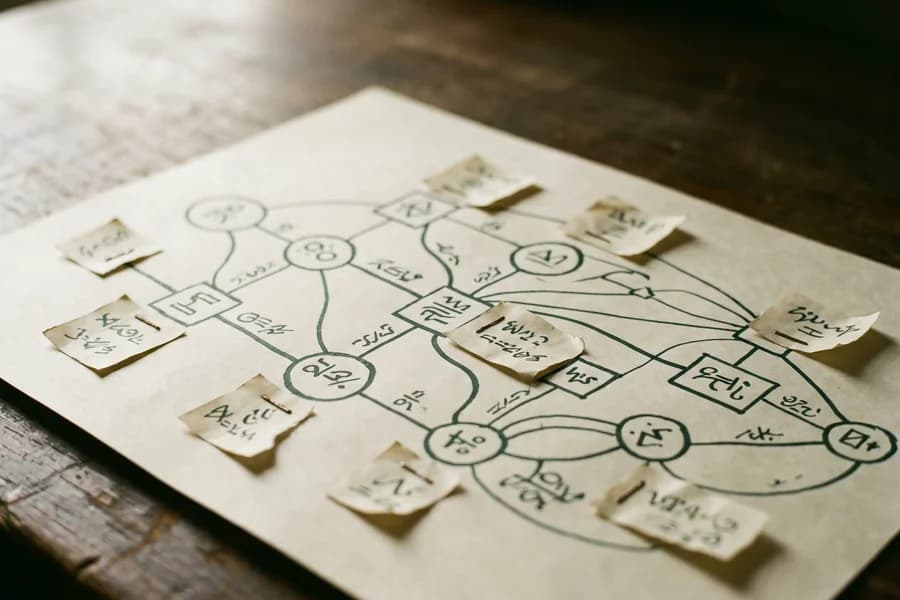
Over time, links create a knowledge graph. Notes become nodes, and links become edges. The graph reveals patterns you didn't consciously design: clusters of related ideas, hub notes that anchor multiple threads, orphaned notes that signal gaps. This structure is emergent—it grows from the relationships themselves, not from a predetermined taxonomy you invented on day one.
The durability comes from the fact that links encode context. When you revisit a note and see which other notes link to it, you're seeing your past thinking made visible. You don't need to remember why the connection mattered; the link itself is the artifact of that decision. And because links are bidirectional—most systems show both outgoing and incoming links—you discover paths through your notes you never planned.
Practically, this means:
- Link early and often. When drafting a note, ask which existing notes it builds on, challenges, or illustrates. Add those links inline.
- Prefer explicit links over tags. If you're tempted to tag a note
#decision-making, link it instead to a note titled "Decision-Making Framework." - Review backlinks regularly. Incoming links show you how a note has been used. That usage history is more valuable than any tag.
- Let hubs emerge. Don't force a hierarchy. Some notes will naturally accumulate many links. Those become your anchors.
Linking integrates naturally with building an AI-powered second brain, where the graph itself becomes the context layer for retrieval and reasoning.
Links are decisions made visible. Tags are intentions that fade.
How LIFE Helps
The LIFE notes module treats note linking as the primary organizational primitive. When you create a note, the interface surfaces related notes based on content similarity, making it effortless to add meaningful links without breaking flow. Backlinks appear automatically, so every note shows both where it points and where it's been referenced. Tags are supported but deliberately de-emphasized—they're metadata, not structure. The module's graph view visualizes your knowledge network, highlighting clusters and gaps. → Start free with LIFE and build a note system that gets stronger over time, not noisier.
FAQ
Should I delete all my existing tags?
No need for scorched earth. Audit your most-used tags and convert the meaningful ones into dedicated hub notes. Link existing tagged notes to those hubs. Let the rest fade—unused tags cost nothing if you stop adding to them.
When are tags actually useful?
Tags work well for ephemeral states or metadata that shouldn't clutter the graph: #draft, #to-review, #from-meeting. Use them for process signals, not for organizing ideas. The moment a tag represents a concept, turn it into a note.
How many links should a note have?
There's no magic number, but if a note has zero links, ask why it exists in isolation. If it has twenty, consider whether you're linking indiscriminately. Most useful notes link to three to seven others—enough to situate the idea without dilution.
Related Reading
Steady wins.