

The moment your calendar crosses 40% meeting density—that is, when scheduled obligations occupy more than two-fifths of your available work hours—your body begins producing elevated cortisol independent of meeting content. Before you consciously register stress, before you acknowledge overwhelm, your heart rate variability drops. The calendar knows before you do.
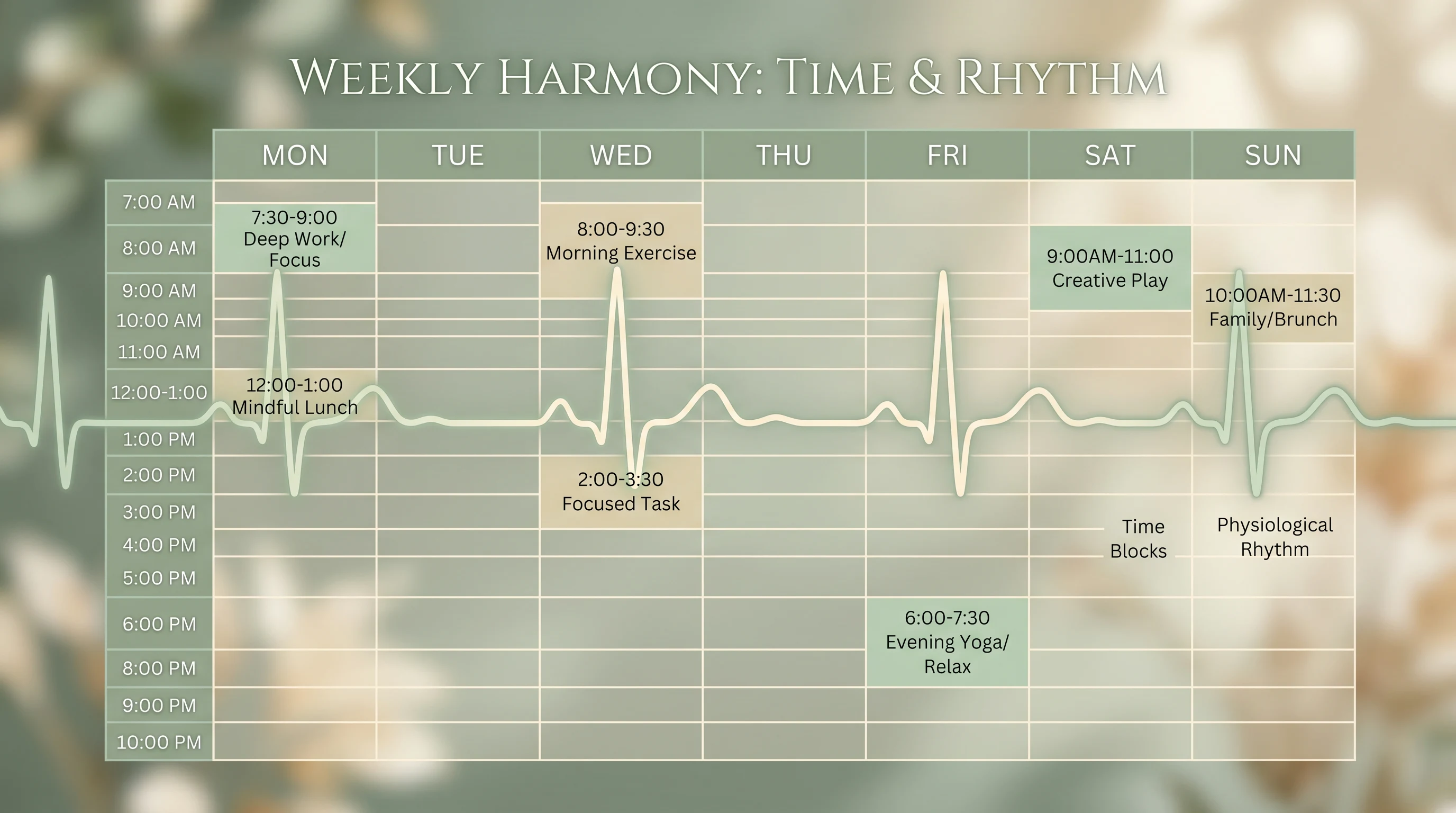 Calendar grid merged with heart rate variability waveform illustrating the physiological connection between meeting density and stress response
Why the Two Modules Look Connected
Calendar density and physiological stress share an evolutionary substrate that neither productivity apps nor fitness trackers were designed to recognize. The human nervous system evolved sophisticated threat-detection mechanisms that scan for resource scarcity—including time scarcity. When your ancestor spotted a predator at dawn and another at midday, the pattern triggered a metabolic shift: cortisol elevation, reduced digestive function, and rapid glucose mobilization. The frequency of threat mattered as much as the threat itself.
Modern meeting density replicates this pattern at a neurological level. A back-to-back schedule doesn't just limit focus time; it signals an environment of sustained demand with insufficient recovery windows. Your hypothalamic-pituitary-adrenal axis cannot distinguish between "three consecutive stakeholder calls" and "three consecutive territorial challenges." Both read as pattern threats.
The calendar, in this framing, becomes a physiological pre-stressor—a documented commitment structure that your nervous system processes before events occur. This is why Sunday evening anxiety correlates with Monday meeting load, and why vacation countdowns produce measurable HRV improvements before the out-of-office activates. Time architecture shapes biology.
What traditional productivity systems miss is that calendar density operates on two axes simultaneously: absolute load (total meeting hours) and fragmentation (meeting distribution across available time). A four-hour workshop produces different physiological markers than eight 30-minute check-ins, even when both consume the same duration. Fragmentation creates cognitive switching costs that compound into sustained autonomic activation—what we observe as background stress even during inter-meeting windows.
The bidirectional relationship emerged clearly once we began observing both data streams in LIFE's CORTEX engine: calendar patterns predict stress markers, and accumulated stress markers predict calendar behavior changes. People under chronic stress begin accepting fewer discretionary meetings, block larger buffers, or—in advanced burnout—stop defending their calendars entirely, leading to paradoxical density increases as boundaries collapse.
What We've Observed at LIFE
The cross-module pattern becomes visible when calendar and body health data converge in a single observational layer. CORTEX tracks both the structural properties of scheduled time and the physiological responses that follow, revealing dynamics that remain invisible to single-domain systems.
We observe that calendar fragmentation—the number of distinct scheduled blocks per day—correlates more strongly with next-day morning HRV suppression than total meeting hours. A user with six meetings distributed across nine available hours shows measurably lower readiness scores than a user with eight hours of meetings contained in a single continuous block. The autonomic nervous system penalizes context-switching at a metabolic level.
The temporal relationship is specific: meeting density on a given day predicts HRV decline that evening and the following morning, with peak impact approximately 18 hours post-schedule. This isn't immediate stress response during meetings; it's a delayed autonomic adjustment as the nervous system processes accumulated demand. By the time users report feeling "burned out," the physiological markers have been present for weeks, visible first in calendar patterns and then in body metrics.
We've learned that recovery ratios matter more than absolute meeting load. Users who maintain at least one 90-minute unscheduled block per day show stable HRV baselines even during high-density weeks. Those who schedule at 75%+ density for consecutive days show progressive HRV decline regardless of sleep duration or exercise consistency. The calendar acts as a chronic stressor that overrides acute recovery interventions.
The pattern holds across work styles. Remote workers show the same calendar-density-to-HRV relationship as office workers, but with a critical difference: remote calendars trend toward higher fragmentation (more, shorter meetings) while office calendars show higher absolute density (longer durations). Both paths lead to the same autonomic dysregulation, via different mechanisms.
There's a weekly rhythm embedded in the data. Calendar density peaks Tuesday through Thursday correlate with Friday morning HRV troughs, creating what appears as "unexplained exhaustion" when Friday calendars are themselves light. The physiological bill for mid-week density comes due with a 48-72 hour lag, making the causal connection invisible without cross-module observation.
We observe defensive calendar behaviors emerging as HRV baselines decline. Users begin scheduling "focus time" blocks that function as stress buffers rather than productivity windows—a compensatory behavior that single-domain calendar apps interpret as time blocking for deep work, but which CORTEX recognizes as autonomic self-protection. The calendar becomes both stressor and attempted remedy.
Vacation patterns reveal the persistence of calendar-induced stress. HRV doesn't normalize on day one of time off; it requires 4-6 days of sustained low calendar density before autonomic markers return to baseline. Long weekends (3 days) produce temporary HRV improvements that fully reverse within 48 hours of calendar resumption. The nervous system is tracking density as a chronic pattern, not an acute event.
Perhaps most telling: we observe that users who receive calendar-density alerts and subsequently reduce meeting load show HRV improvements within 72 hours, while users who receive the same alert but maintain density show continued HRV decline. The intervention point is the calendar architecture, not the stress response itself. You cannot optimize your way out of a structural schedule problem.
The Mechanism: How Calendar Density Drives Burnout
The pathway from calendar structure to physiological dysregulation runs through cognitive and metabolic channels that compound over multiple timescales.
Predictive allostatic load is the first mechanism. Your autonomic nervous system doesn't wait for meetings to begin before mounting a stress response; it anticipates known demands. When you wake to a calendar showing six scheduled obligations, your HPA axis initiates preparatory cortisol elevation and sympathetic activation. This is metabolically adaptive for acute challenges but becomes pathological under chronic density.
The calendar functions as a commitment ledger that your nervous system pre-processes. Dense calendars create what amounts to predictive stress—your body begins paying the metabolic cost of scheduled demands hours before they occur. This is why morning HRV correlates with that day's calendar density: the schedule itself is a biological stressor, independent of meeting content or outcome.
Fragmentation compounds switching costs through a secondary pathway. Each calendar transition—meeting to meeting, meeting to open time, open time to meeting—requires executive function overhead: mental context loading, priority reassessment, and attention reorientation. These aren't just productivity drags; they're metabolically expensive cognitive operations.
When calendar fragmentation exceeds your available attentional capacity (which varies by baseline HRV and sleep quality), the nervous system interprets the sustained switching demand as environmental chaos. The result is elevated baseline cortisol and suppressed parasympathetic tone—the physiological signature of chronic unpredictability. You feel scattered because your biology is responding to structural calendar chaos.
The third mechanism is recovery window collapse. Autonomic nervous system regulation requires periodic parasympathetic dominance—windows where sympathetic demand drops and the vagus nerve can reassert homeostatic control. These windows typically require 45-90 minutes of unscheduled, low-demand time.
High calendar density systematically eliminates these recovery windows. Even when meetings themselves are low-stress, the absence of recovery intervals prevents autonomic reset. This creates a ratcheting effect: each day's sympathetic activation carries forward into the next, building allostatic load that manifests as progressive HRV decline, sleep fragmentation, and eventually, subjective burnout.
The metabolic impact is measurable. Sustained calendar density drives glucose dysregulation (cortisol-mediated), inflammatory marker elevation (sympathetic dominance), and immune suppression (failed parasympathetic recovery). These aren't psychological phenomena; they're documentable physiological changes driven by time architecture.
The Reverse Effect: How Burnout Loops Back
The bidirectional relationship creates a self-reinforcing cycle that accelerates without intervention. As physiological stress markers accumulate—suppressed HRV, elevated resting heart rate, poor sleep efficiency—users make predictable calendar behavioral changes that worsen density rather than improve it.
We observe what appears as paradoxical calendar surrender: burned-out users stop protecting their time. They accept meeting invitations with declining scrutiny, abandon time-blocking practices, and allow calendars to fill reactively. This isn't motivational failure; it's an executive function collapse downstream of chronic autonomic dysregulation. The cognitive capacity required to maintain calendar boundaries is itself depleted by the stress the calendar created.
Simultaneously, poor body health metrics drive calendar compensation behaviors: scheduling more check-ins to stay aligned despite reduced focus capacity, accepting earlier meetings to "get ahead" of fatigue, or loading calendars densely in an attempt to preserve specific days for recovery. These interventions increase overall density while subjectively feeling like stress management.
The feedback loop is metabolically expensive: high density drives HRV suppression, which impairs sleep quality, which reduces next-day capacity for cognitive work, which increases reliance on meetings for collaboration, which further increases density. The system spirals unless one variable is externally interrupted.
Calendar · daily shape
Calendar Density Score
Three inputs reveal the real shape of your workday — and how much room you’ve actually left for the work that matters.
How LIFE Surfaces This Pattern
CORTEX is the only inference layer that observes calendar architecture and body health telemetry simultaneously, enabling recognition of the cross-module pattern in real time.
The Calendar Density Index synthesizes structural calendar properties—absolute meeting load, fragmentation score, recovery window availability, and multi-day density trends—into a single metabolic risk metric. This isn't productivity optimization; it's autonomic exposure calculation. LIFE measures what percentage of your available time is architecturally committed and what distribution pattern that commitment takes.
In parallel, the Body Health module continuously ingests physiological markers: HRV from wearable devices, resting heart rate trends, sleep stage distribution, and—when available—subjective stress logs. These signals feed CORTEX's temporal correlation engine, which maps physiological changes to calendar events with timestamp precision.
The integration surface is a predictive stress alert that fires before you feel burned out. When CORTEX detects that your rolling three-day calendar density has crossed the threshold historically correlated with HRV decline (a threshold personalized to your baseline), it surfaces a notification: "Your calendar load this week is tracking toward stress markers. Consider defending Thursday afternoon."
This isn't generic wellness advice; it's a time-specific, physiology-grounded intervention derived from observing both modules simultaneously. The alert includes calendar modification suggestions calibrated to your body's recovery patterns—because CORTEX knows how many unscheduled hours your nervous system requires to restore HRV baseline.
The system learns your individual density tolerance. Some users maintain stable HRV at 60% calendar density; others show dysregulation above 35%. LIFE doesn't impose universal thresholds; it identifies your breaking point by observing when calendar patterns consistently precede your physiological stress markers.
Weekly Density Reports show the pattern longitudinally: a visual overlay of calendar density curves and HRV trends across the past month, making the 48-hour lag relationship visible. Users see that Wednesday's back-to-back sprint correlates with Friday's fatigue—a connection invisible when viewing calendar and body health data in separate apps.
When you do reduce calendar density in response to CORTEX alerts, LIFE tracks the physiological payoff: HRV improvement within 72 hours, sleep quality changes, and subjective energy ratings. This closes the feedback loop, reinforcing the calendar-body connection through observed outcome data rather than generic wellness platitudes.
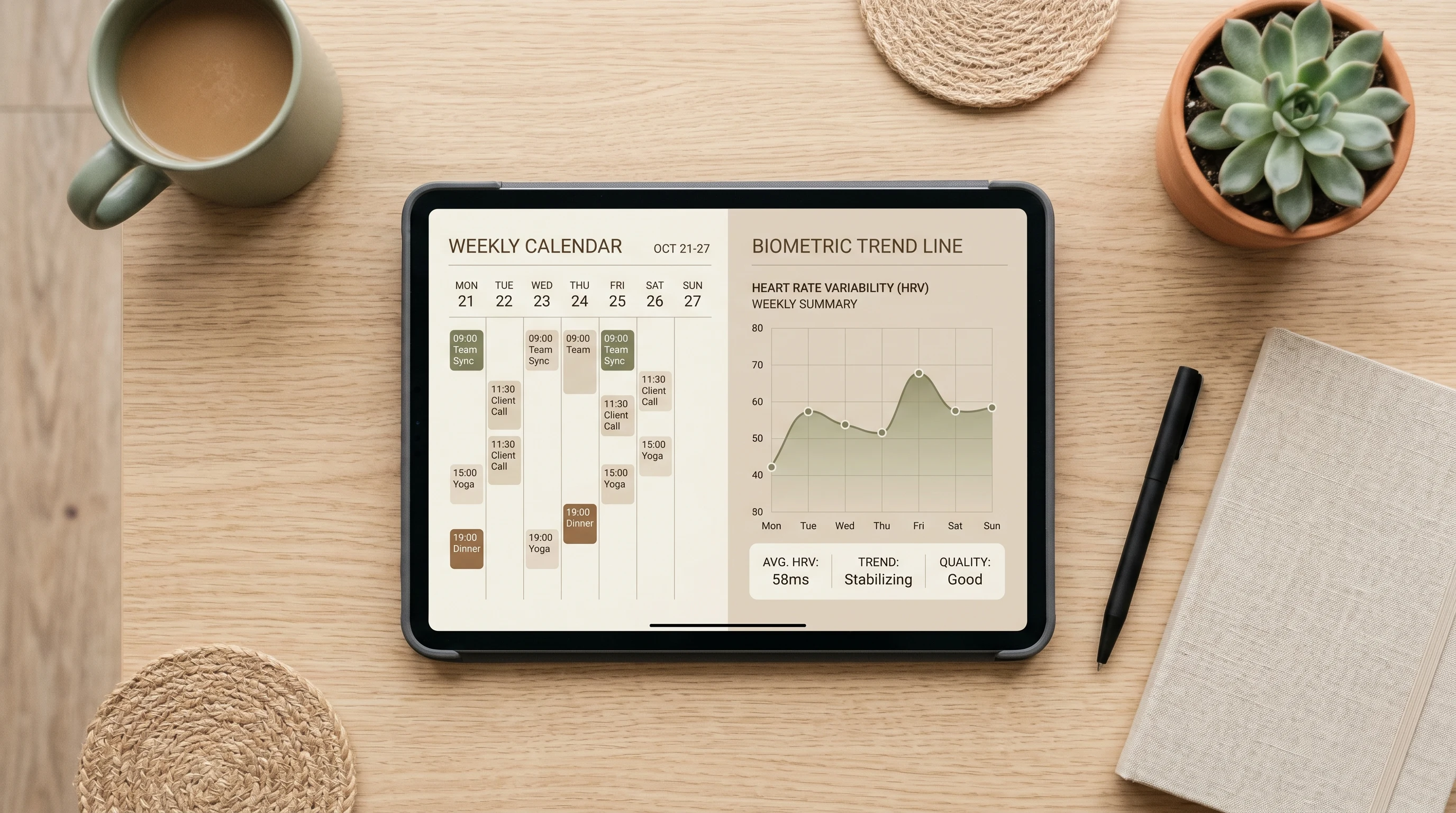 LIFE app interface showing synchronized calendar density metrics and HRV trends side by side
Putting It Into Practice This Week
Even without CORTEX, you can begin observing the calendar-burnout pattern using accessible tools and deliberate attention.
Audit your calendar fragmentation by counting distinct scheduled blocks per day. If you're consistently above six separated events, you're in high-fragmentation territory regardless of total meeting hours. Experiment with consolidating: move two 30-minute check-ins into a single 60-minute block and observe whether your end-of-day energy shifts.
Track subjective stress alongside your calendar. Each evening, note a 1-10 stress rating and review that day's calendar density. After two weeks, look for the temporal pattern: does high density correlate with elevated stress that same day, or is there a lag? Most people find the lag, which means today's overwhelm reflects yesterday's or the day before's schedule.
Defend one 90-minute block per day as non-negotiable recovery time. This isn't focus time for deep work; it's metabolic space for autonomic reset. No meetings, no scheduled obligations. Observe whether protecting this window stabilizes your weekly energy baseline.
If you use a wearable that tracks HRV or resting heart rate, review those metrics weekly and compare them to your calendar density for the same period. You're looking for the inverse relationship: density peaks preceding HRV troughs by 24-48 hours. When you find it, you've identified your personal calendar-burnout threshold.
FAQ
What is calendar density and how is it measured?
Calendar density is the proportion of your available time occupied by scheduled commitments, measured as a percentage. It accounts for both total meeting duration and fragmentation—the distribution of those meetings across your day. A 50% dense calendar means half your available hours are scheduled, but fragmentation determines whether those hours are consolidated or scattered across many transitions.
How does calendar density cause burnout before you feel stressed?
Your autonomic nervous system processes your calendar as a predictive stressor, mounting physiological responses before meetings begin. When density is chronically high, this creates sustained sympathetic activation and suppresses parasympathetic recovery windows. The result is measurable HRV decline, cortisol elevation, and metabolic dysregulation that accumulates for weeks before subjective burnout symptoms emerge.
Can you prevent burnout just by optimizing your calendar?
Calendar architecture is the most upstream intervention point for autonomic stress patterns driven by meeting load. Reducing density and fragmentation reliably improves HRV and other stress markers within 72 hours, provided other major stressors remain stable. It's not sufficient for all forms of burnout, but it's necessary when calendar density is the primary driver—which cross-module observation reveals is far more common than single-domain tracking suggests.
What's the difference between calendar density and just being busy?
Busy is subjective and often references productive activity or task volume. Calendar density is structural: the measured proportion of time committed to scheduled obligations. You can feel busy with low calendar density (high task load, minimal meetings) or feel spacious with high density (well-managed expectations, low urgency). Density matters for burnout because it's what your autonomic nervous system tracks—committed time architecture, not subjective busyness.
How much calendar density is sustainable long-term?
Individual thresholds vary based on baseline HRV, sleep quality, and recovery capacity, but we observe inflection points. Most users maintain stable physiological markers below 45-50% calendar density. Above 60%, nearly everyone shows progressive HRV decline. Between those ranges, sustainability depends on fragmentation, recovery window availability, and weekly rhythm—high density contained to 2-3 days with protected recovery days is more sustainable than moderate density across all five weekdays.
Why does HRV drop after high-density days even if meetings went well?
HRV reflects autonomic nervous system regulation, not emotional response to meeting content. Even productive, positive meetings require cognitive switching, executive function, and sustained attention—all of which are metabolically demanding. High calendar density depletes these resources regardless of subjective satisfaction. The HRV drop is your nervous system processing accumulated demand and attempting recovery, not an indicator that meetings were stressful in the conventional sense.
What's the optimal time block size for preventing burnout?
We observe that unscheduled blocks of at least 90 minutes support autonomic recovery most effectively. These windows allow parasympathetic dominance to reassert, which is required for HRV restoration. Shorter blocks (30-45 minutes) provide cognitive switching relief but often don't last long enough for full physiological reset. For meeting consolidation, 90-120 minute continuous blocks create fewer autonomic transitions than the same duration fragmented into shorter segments.
Can LIFE detect burnout before I realize I'm heading toward it?
Yes—this is CORTEX's primary function for the calendar-body health cross-pattern. By observing the temporal relationship between your calendar density and physiological stress markers, LIFE identifies when density patterns historically correlated with your HRV decline are recurring. The alert fires during the calendar pattern phase, before HRV suppression fully manifests and well before subjective burnout symptoms. The intervention point is architectural: modify the calendar before your body pays the metabolic cost.
 Peaceful unscheduled time represented by an empty desk with natural elements and soft lighting
Calendar density doesn't just correlate with stress—it predicts HRV decline 48 hours before you feel burned out.
The pattern is architectural, measurable, and modifiable. Most life systems track calendar events or body metrics, but cannot see how one drives the other because they operate in isolated modules. LIFE's CORTEX observes both simultaneously, making the burnout pathway visible at the intervention point: your schedule structure, before your biology pays the price.